Exterior mosquito and tick barrier applications target pest populations where they shelter and breed across Polk County. In riverfront and wooded neighborhoods such as Waterbury, Salisbury Oaks, and Beaverdale, dense…
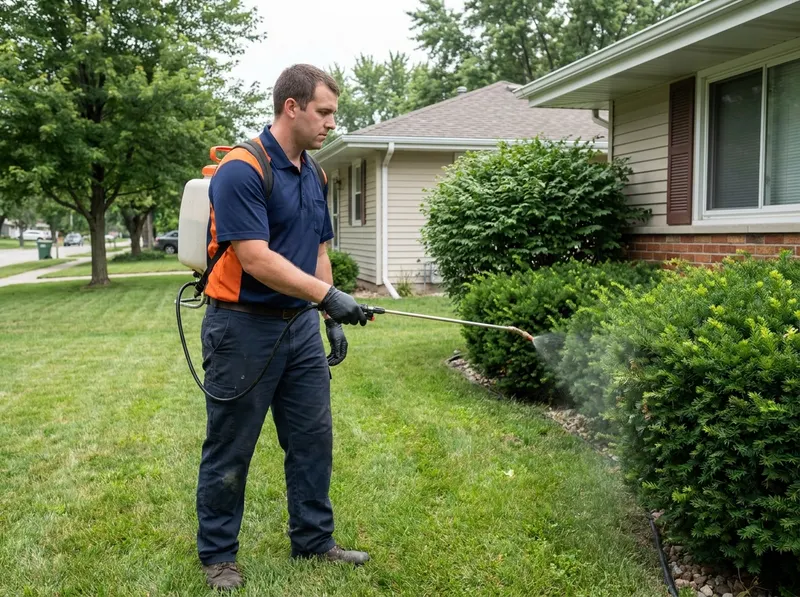
Exterior mosquito and tick barrier applications target pest populations where they shelter and breed across Polk County. In riverfront and wooded neighborhoods such as Waterbury, Salisbury Oaks, and Beaverdale, dense mature canopies and proximity to waterways like the Raccoon River create microclimates of high humidity. Adult mosquitoes rest on the undersides of broadleaf foliage during daytime heat, while blacklegged ticks quest along tall turf margins and shaded mulch borders near properties along Grand Avenue and Ingersoll Park. Standard broadcast fogging dissipates quickly in open wind; a structured barrier application adheres to resting surfaces using weather-resistant polymer surfactants, sustaining an active residual kill zone through seasonal rain showers.
Decision guidance dictates selecting targeted barrier suppression during peak active vector seasons from May through October rather than automated yard misters or personal topical repellents. Automatic misters deposit unshielded active solutions across non-target zones, creating runoff risks near stormwater basins in Sherman Hill and Capitol East, while spatial repellers only offer localized, temporary protection within a 15-foot radius. The perimeter barrier method establishes an unbroken chemical tripwire around property perimeters. The technical trade-off involves application timing: treatments require 30 to 45 minutes of dry post-application cure time to achieve bonding, meaning applications pause during active precipitation windows.
Properties near high-moisture drainage channels such as Gray's Lake Park or the dense garden corridors of Waveland Park encounter heavy migration pressure from wild vector reservoirs. Technicians systematically map standing water reservoirs, French drains, and uncleaned gutters before applying microscopic barrier layers to resting zones up to 10 feet vertically. Microencapsulated formulations lock active pyrethroids into micro-beads that release steadily over 21 to 30 days, preventing rapid degradation from intense midwestern ultraviolet exposure. Children and domestic animals can re-enter treated lawns once the liquid vehicle dries entirely, typically within one hour.
Every job gets a firm, written price after a free on-site visit.
Tell us about your exterior mosquito & tick barrier job in DesMoines and we'll send a clear, written quote, usually the same day.
 Dextaro Pest Response